
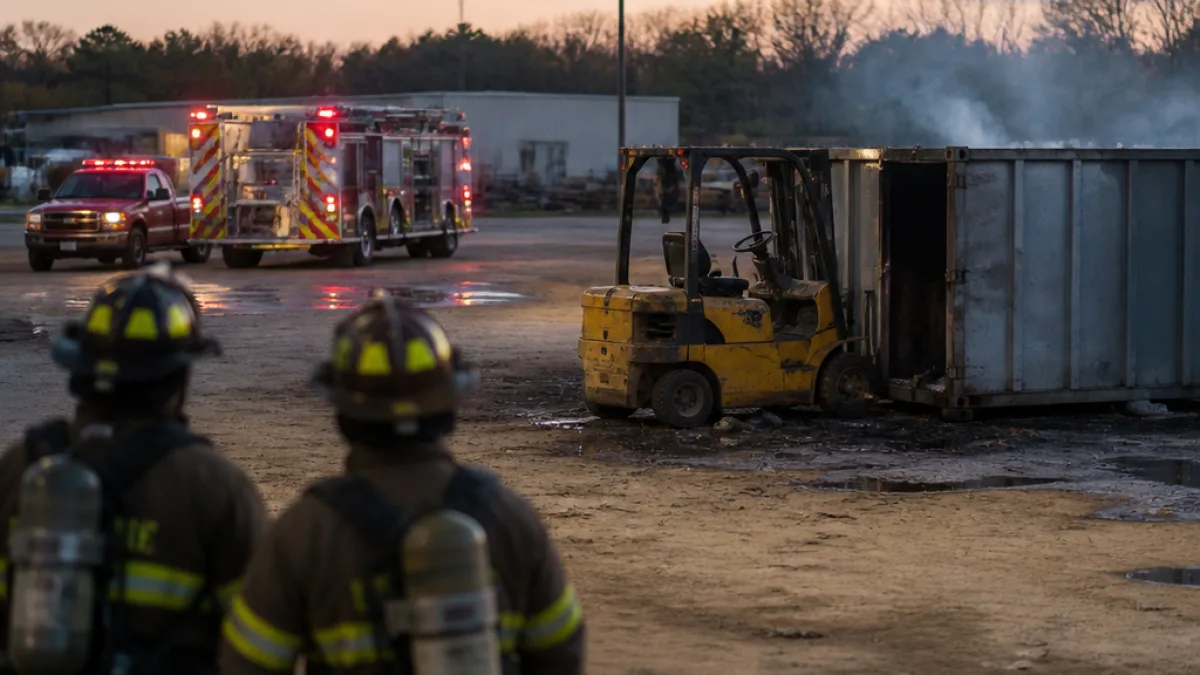
Fire crews responded Monday, Oct. 26, to an industrial park on Mammoth Road after a lithium‑ion battery that had been powering a forklift began overheating and smoking, officials said.
Battalion Chief Bruce Hallowell of the Londonderry Fire Department said the battery was in thermal runaway, a condition in which cells overheat and can lead to fire or explosion. Workers at the facility removed the battery from the building before firefighters arrived, Hallowell said.
The department's hazardous materials team developed a mitigation plan that involved placing the battery in a fire‑resistive container and filling that container with a medium intended to stop further thermal runaway, Hallowell said. Fire crews established an exclusion area while they secured the device.
what responders did
- Workers moved the battery outdoors and evacuated the building.
- Fire crews set up an isolation zone to keep people at a safe distance.
- The hazardous materials team placed the battery in a fire‑resistive container and used a medium to prohibit further thermal runaway.
- Facility employees were evaluated for potential health issues by responders.
- The property managers were directed to contract with a disposal company to remove the battery.
Manchester Fire Marshal Mitchell Cady, cited in the account, said lithium‑ion batteries are common in consumer electronics and industrial equipment and that improper charging or damaged cells can lead to thermal runaway. He urged people to follow manufacturers' charging instructions and to avoid charging devices in unsafe locations.
“If a battery begins having a strange odor, swelling, smoking, or making any unusual sounds, it could be a sign of thermal runaway,” Cady said. “If you notice this, don't do anything on your own. Unplug the device, move away from it, and call first responders, because things can change quickly.”
Hallowell described the standard on‑scene approach as one of containment and distancing until specialists can stabilize the battery. He said the facility's property managers are responsible for arranging proper disposal through a qualified handler.
The incident underscores growing concerns among emergency responders about the risks posed by lithium‑ion batteries as their use expands in workplaces, warehouses and consumer products across New Hampshire. Fire departments increasingly train hazardous materials teams to handle battery incidents and to use specialized containers and suppressants to reduce the risk of reignition or explosion.
No injuries or structure fires were reported in the Londonderry incident, and the battery mitigation was handled on site, Hallowell said.