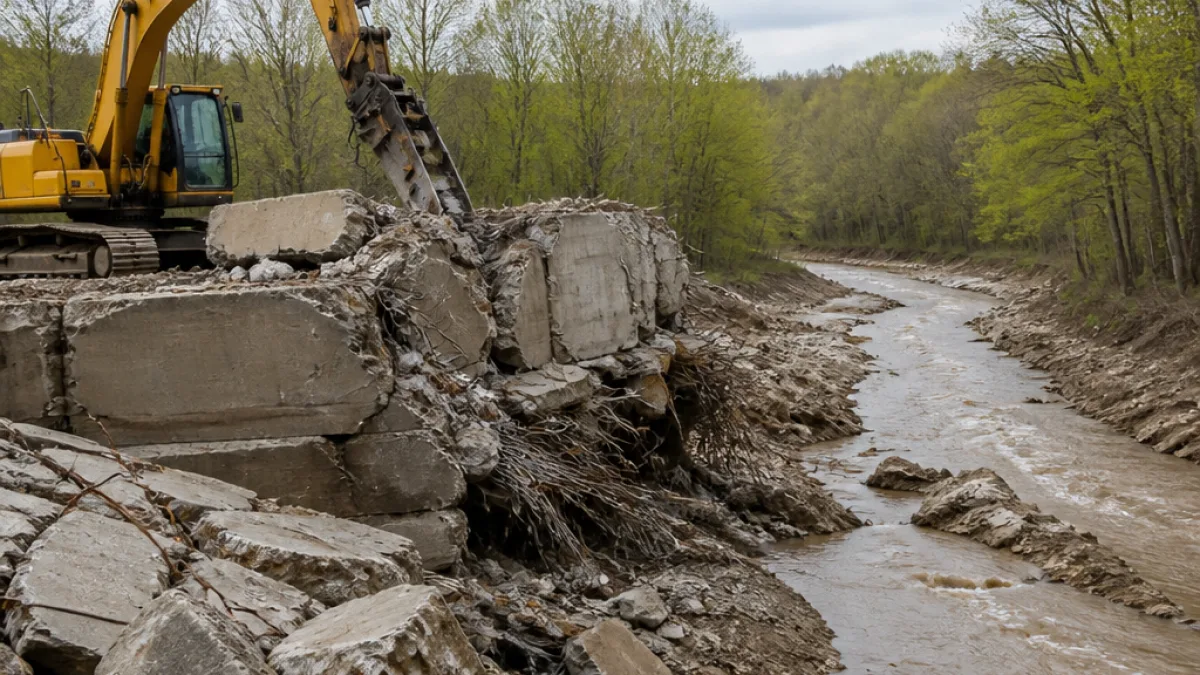
Work to remove the Mill Pond Dam on the Oyster River is underway after years of town debate and state agency warnings, officials said. The structure that long separated freshwater and saltwater sections of the river has been drained and cleared as crews re-establish the river’s natural channel.
timeline and costs
The New Hampshire Department of Environmental Services in February 2018 identified deteriorating concrete and exposed steel reinforcement at the dam and told the town to stabilize or remove the structure, prompting a multiyear review that included engineering studies and public meetings. In March 2022, Durham voters upheld a Town Council decision to remove the dam, with 74% voting in favor.
Beginning in the summer of 2026, traffic detours on Mill Pond Road signaled the start of on-site work. Durham Town Administrator Todd Selig has said the removal process is expected to be mostly finished by the end of fall 2026.
The town now expects the removal to cost more than $3.1 million, well above earlier estimates but still lower than the roughly $4.2 million that would have been required to repair and maintain the dam, according to local officials and advocacy groups. Early estimates favored by removal proponents in 2022 estimated costs near $1.4 million.
| Estimate | Amount |
|---|---|
| Removal (current estimate) | $3.1 million+ |
| Removal (2022 estimate) | $1.4 million |
| Repair/maintenance estimate | $4.2 million |
ecological expectations
Conservationists in Durham predict the project will improve fish passage and water quality. The Durham Conservation Commission has said restoring the natural river channel should help sea-run species, citing blueback herring and alewives as the most common fish in the Oyster River. The commission has argued that the dam’s fish ladder could not replicate the mobility afforded by an unobstructed channel and that the dam trapped nutrients and sediment.
- DES inspection in Feb. 2018 prompted action on the dam.
- March 2022 town vote backed removal by 74% of voters.
- Removal began summer 2026; substantial completion expected by end of fall 2026.
The town’s timeline and the projected costs were discussed publicly in planning documents and interviews with town officials. The work will re-establish a natural channel through the former impoundment area and is intended to address long-standing structural and ecological concerns raised by state and local agencies.
Contracting, funding sources and ongoing monitoring plans are being handled through the town’s public works and conservation offices as the project proceeds.