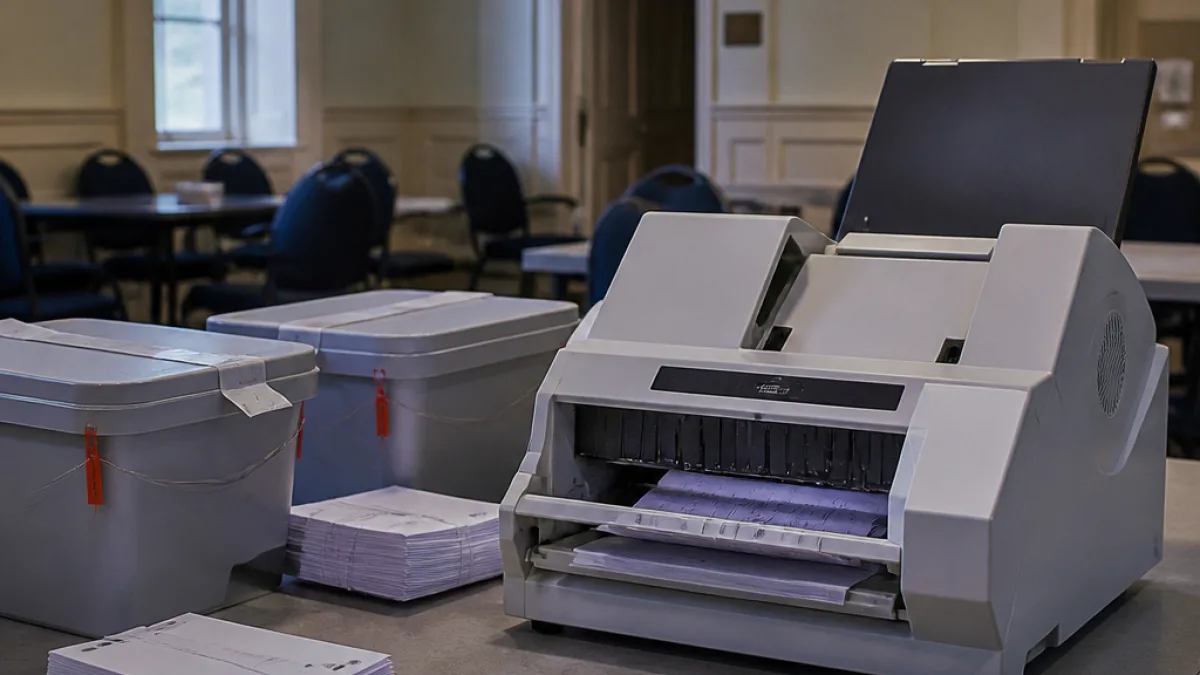
New Hampshire Secretary of State David Scanlan is rejecting a request from 10 Republican state representatives for broader physical inspections of the electronic devices used to count paper ballots before the Nov. 3 general election.
The lawmakers raised their concerns in an Oct. 26 letter questioning whether the equipment deployed by municipalities had been sufficiently checked to ensure it lacks network capabilities. They asked the state to disclose machine components, inspect a statistically meaningful sample of devices and confirm that locally purchased equipment matches configurations approved for use in New Hampshire.
Scanlan responded in correspondence to the legislators, Gov. Kelly Ayotte and Attorney General John Formella. He said the state’s two approved systems, Liberty Votes and VotingWorks, do not have network functionality. State law bars electronic ballot-counting devices from connecting to or accessing the internet.
State says existing safeguards are sufficient
Scanlan cited assurances from the companies that make the systems and independent laboratory testing conducted through the federal Election Assistance Commission’s certification program. He said those reviews, along with the state’s election procedures, do not warrant the additional inspections requested by the lawmakers.
The secretary of state also addressed a report from a Nashua moderator who detected radio-frequency readings near a ballot counter. A cybersecurity expert consulted by Scanlan’s office said a radio-frequency detector can pick up energy from sources including nearby cellphones. The presence of a reading alone cannot demonstrate that a device is transmitting information, has a network connection or can reach the internet, according to Scanlan’s account of the expert’s assessment.
Scanlan said the Nashua readings did not alter the state’s conclusion that the ballot counter cannot connect to the internet. New Hampshire voters use paper ballots, which are counted electronically and remain subject to additional election safeguards.
- Public testing of the equipment is conducted before each election.
- Tamper-evident seals, custody logs and secure storage are used to protect the devices.
- Election officials supervise the equipment, while the attorney general’s office conducts inspections at polling places.
- Post-election audits and hand recounts are used to check machine-count results.
The concerns come as state and local election officials prepare for voting on Nov. 3. Scanlan’s response maintains that the combination of certification testing, pre-election procedures and post-election reviews provides the verification requested by the lawmakers without requiring a new statewide inspection program.