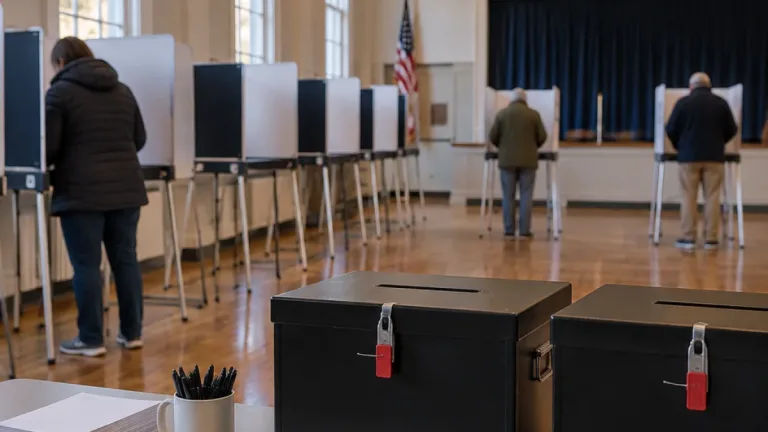
New Hampshire’s Nov. 3 general election is testing a voting pattern that has become familiar in the state: voters choosing candidates from different parties for state and federal offices. Republican Gov. Kelly Ayotte is seeking another term against Democratic nominee Cinde Warmington, while Democratic Rep. Chris Pappas and Republican John Sununu are competing for the open U.S. Senate seat.
The governor’s race has shown a different direction from the contests for federal office, according to recent polling cited by Seacoastonline. An Oct. 22 poll from the Saint Anselm College Survey Center found voters leaning toward Pappas over Sununu in the Senate race while favoring Ayotte over Warmington in the governor’s contest. The poll details provided in the coverage did not include a sample size or margin of error.
New Hampshire voters backed former Vice President Kamala Harris in the 2024 presidential election, but the state has also elected Republicans to statewide offices. The state’s voting history includes elections in which voters supported Democratic candidates for federal offices and Republican candidates for state offices, as well as elections that produced different party outcomes within state government.
Dante Scala, a political science professor at the University of New Hampshire, said the pattern has continued during the Trump era.
“We have seen all during the Trump era really this kind of split-ticket tendency. (The) Trump era has been bad for New Hampshire Republicans in some ways, but for federal office, not for state office.”
State control is also at stake
The governor’s margin could be relevant to the contest for control of the 400-member House of Representatives and the 24-member Senate. Republicans currently hold majorities in both chambers, and the election is taking place amid national political conditions that have benefited Democrats in several governor’s races, according to race forecasters cited in the coverage.
Democrats have strong opportunities to win governor’s offices in Alaska, Iowa and Ohio, with additional opportunities identified in Georgia and Wisconsin. Those states voted for President Donald Trump in 2024, while New Hampshire voted for Harris by a narrow margin. The contrast has made New Hampshire part of a broader question about whether voters will separate their choices for state and federal offices.
- Governor: Ayotte is running against Warmington.
- U.S. Senate: Pappas is running against Sununu.
- Legislature: The election will determine whether Republicans retain their majorities in the House and Senate.
Ayotte’s predecessor, former Gov. Chris Sununu, won re-election in 2018 and 2020, when national Republicans and Trump also faced difficult political conditions. The Nov. 3 results will provide the official measure of whether New Hampshire voters again divide their choices between state and federal candidates.